

Strategy Framework & Methodology
Our 3 Phase Framework
Even for senior leaders, strategy is often elusive and poorly defined. To address this, we developed a simple, practical framework that anyone involved in strategy can use. It synthesizes the most actionable insights from leading strategy thinkers along with more than a decade of real-world application, refinement, and teaching.
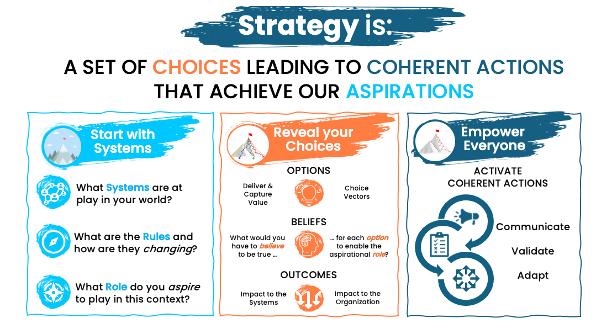
We define strategy as:
A set of choices that lead to coherent actions to achieve your aspirations.
This emphasis on choice is intentional. Too often, strategy is treated as a linear planning exercise rather than a set of deliberate decisions under uncertainty.
-
Understand the system you are operating within before making choices.
What systems are at play in your world?
What are the rules, and how are they changing?
What role do you aspire to play in this context?
This phase grounds strategy in reality by surfacing constraints, dynamics, and forces that shape what is possible.
-
Make strategic choices explicit by separating options, beliefs, and outcomes.
Options – The different paths you could take (choice vectors).
Beliefs – What must be true for each option to succeed.
Outcomes – The impact on both the system and the organization.
Coaching is critical here to uncover hidden beliefs, challenge default thinking, and expand the range of viable choices.
-
Turn strategy into action through alignment, learning, and adaptation.
Activate coherent actions
Communicate clearly and consistently
Validate beliefs with data and feedback
Adapt as learning occurs
Strategy only works when people understand it, believe in it, and can act on it.
Our Methodology

Trigate System Stability Analysis©
A lens to understand whether your industry is stable or undergoing fundamental change—and what that means for strategy. It helps leaders assess shifting rules, emerging tipping points, and whether the right response is optimization, adaptation, or exploration.
Trigate’s Three Waves of AI Transformation©
A framework that shows how AI reshapes industries over time—from efficiency gains, to new capabilities, to full industry transformation. It helps leaders anticipate where value is moving, what triggers the next wave, and how to stay relevant as roles and business models evolve.
Choice Vectors (Directional Choices)
A practical tool that turns strategy into explicit trade-offs. Choice vectors map key decisions along clear continuums (e.g., focus vs. breadth, product vs. platform), helping leaders see how options truly differ and make deliberate, aligned choices.

Strategic Positioning Report
A practical, evidence-based report offering a strategic positioning analysis using the Trigate Strategy Framework, which includes the Systems Stability Analysis, Three Waves of AI, and Choice Vectors. It draws on public sources and client-provided context to deliver fresh, evidence-based insights to inform executive decision-making.